Pakistan Tightens Rules on Used Vehicle Imports, Ends Personal Baggage Scheme Syndicate Journal Pakistan
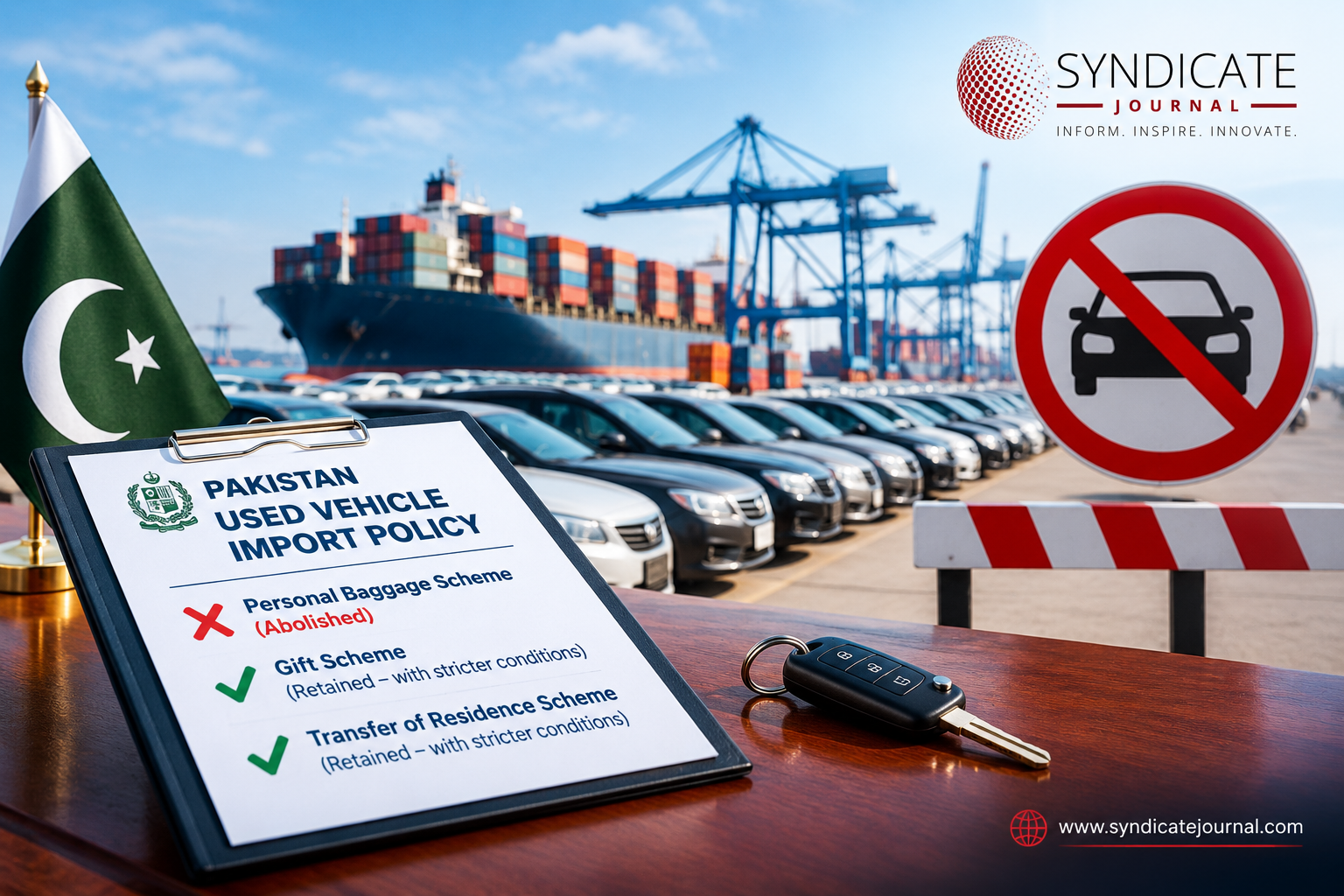
Pakistan has moved to tighten regulations governing the import of used vehicles by abolishing the Personal Baggage Scheme, a facility that had increasingly raised concerns over misuse for commercial purposes.
The decision, approved by the relevant government authorities, aims to prevent preferential import facilities intended for overseas Pakistanis from being exploited as alternative channels for commercial vehicle imports.
While the Personal Baggage Scheme has been discontinued, the government has decided to retain the Gift Scheme and Transfer of Residence Scheme. However, both remaining facilities will operate under stricter eligibility requirements and additional safeguards.
Under the revised framework, individuals seeking to import vehicles through these schemes will face tighter conditions. The interval for availing the facility has reportedly been extended from two years to three years, while imported vehicles will remain non-transferable for a specified period.
Eligibility requirements relating to an individual’s stay abroad have also been strengthened. In addition, imported vehicles will be required to comply with applicable safety, environmental and regulatory standards.
The policy shift reflects a broader effort to distinguish genuine overseas Pakistanis from commercial operators attempting to benefit from concessions designed for personal use.
For years, special import schemes have provided an important facility for Pakistanis living abroad who wish to bring vehicles home or send them to family members. However, concerns emerged that these arrangements were sometimes being used by commercial interests, creating an uneven playing field for businesses operating through regular import channels.
The abolition of the Personal Baggage Scheme is therefore expected to close one such avenue. The effectiveness of the new policy, however, will largely depend on enforcement.
Simply introducing stricter rules may not be sufficient if eligibility checks and monitoring mechanisms remain weak. Authorities will need to closely examine import patterns and ensure that the remaining schemes are not used as substitutes for commercial imports.
Particular attention will also be required to prevent the use of proxies or other arrangements designed to bypass eligibility requirements.
Beyond the immediate issue of vehicle imports, the decision highlights a wider policy challenge: concessions introduced for specific groups should ultimately benefit their intended recipients. When such facilities become vulnerable to commercial exploitation, they can distort competition, encourage rent-seeking and undermine the original purpose of the policy.
The government will now need to monitor the impact of the revised rules on overall used-vehicle imports and assess whether the remaining schemes are functioning as intended.
Closing a loophole is an important first step. Ensuring that similar loopholes do not emerge elsewhere will be the real test of the reform.
About the Author